
1962 Daimler Dart SP250 – The under-the-radar British V8 roadster
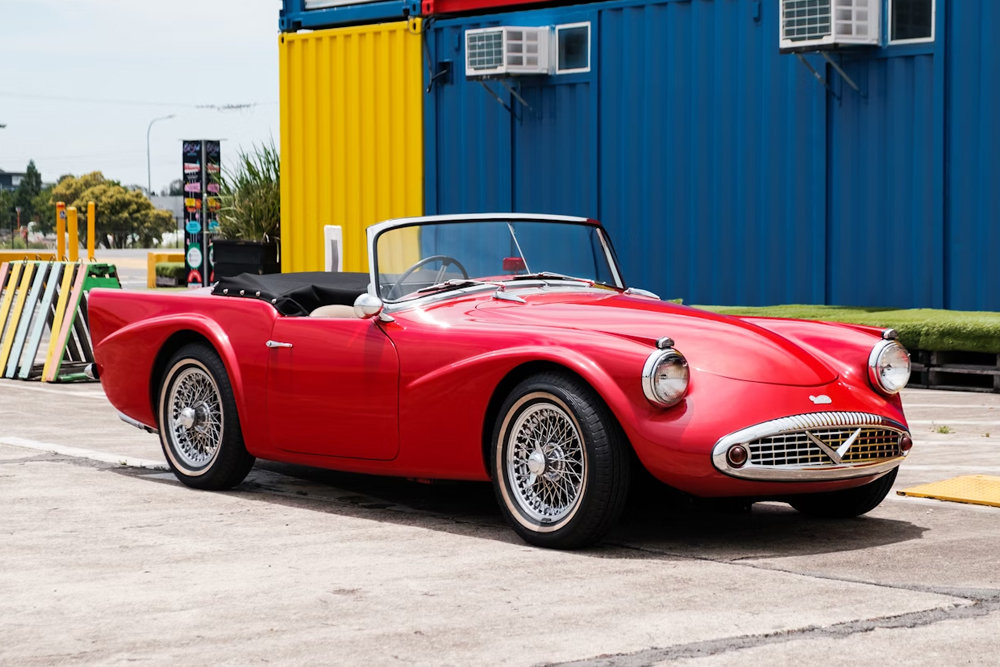
The 1962 Daimler Dart SP250 is a rare slice of Britain’s motoring past: quirky to look at, surprisingly serious to drive. Its doll-like front fascia and flowing fibreglass body hide the headline—a compact 2.5-litre “Hemi-head” V8 in a lightweight two-seat convertible.
At a local classic meet in Australia, the Dart draws people in because it’s unfamiliar. Australian-delivered examples are often described as uncommon, and sources also note police use in Australia and New Zealand.
Styling, fibreglass, and the “Dart” story
“Dart” wasn’t a nickname—Daimler launched the car with that name in 1959. The catch was that the name already belonged to Chrysler’s Dodge division in the United States, so Daimler shifted quickly to the internal project code “SP250”, which became the official model designation.
Fibreglass was chosen for practical reasons: it reduced tooling cost and helped Daimler bring a niche sports car to market quickly. The early downside was rigidity—first-series cars earned a reputation for flex, and later “B-spec” and subsequent updates improved stiffness and usability.
The 2.5-litre Hemi-head V8 that makes it
The SP250’s Edward Turner-designed 2,547cc V8 used hemispherical combustion chambers in aluminium heads—hence the “Hemi-head” label. Period sources often quote around 140 bhp, and the car weighed a little over 2,000 lb, giving it vivid early-1960s performance.
Daimler also backed the engine with strong hardware for the era. Four-wheel disc brakes were part of the package, and buyers could choose a four-speed manual or a Borg-Warner automatic; the automatic became particularly associated with police use because it suited intensive stop-start duty and reduced clutch wear.
What it feels like from the driver’s seat
The cabin is pure early-’60s charm: wood and leather, a timber steering wheel, and Smiths instruments prominently set into the dash in many restored examples. Turn the key and the small V8 settles into a burble that can surprise anyone expecting polite British manners.
On the road, the Dart rewards momentum and smooth inputs. Steering is typically heavy at low speeds (there’s no power assistance), braking can be very effective with a firm pedal, and the car’s light weight makes it feel agile and responsive once rolling.
Police pursuit pedigree and Australian context
The SP250’s best-known story is also its most improbable: it became a police chase car. The Metropolitan Police in London is widely documented as operating 26 SP250s for traffic and high-speed pursuit duties in the early 1960s, and period road tests recorded top speeds around 125 mph.
That policing connection unexpectedly reaches Australia too. Classic & Sports Car notes production ended in September 1964, yet the factory produced two more special-order cars for Australian police the following month—an unusual footnote that underlines how this roadster punched above its weight globally.
Collectability and value outlook
The SP250’s place in history is sharper than many people realise. Daimler’s roots run deep: the brand was formed in 1896 and is often credited with helping lay the foundations of Britain’s motor industry. Launched by The Daimler Company under Birmingham Small Arms Company ownership, the SP250 was the last new Daimler model introduced before Jaguar Cars bought the Daimler business in 1960. Production continued until 1964, and total build is commonly described as about 2,650 cars (often quoted in the 2,648–2,654 range depending on the reference).
Values have been quietly firming as collectors seek distinctive classics beyond the usual Jaguar/Triumph/MG roster. Auction tracking shows real demand when good examples surface, including recorded sales in Australia that can reach mid–five figures depending on condition and originality.
Ready to add a hidden British V8 gem to your garage? CCI | Classic Car Imports can help you source the right Daimler Dart SP250 globally, verify its history and condition, and manage the import journey into Australia so you can focus on the best part: owning and driving a truly uncommon classic.
References
- Hagerty – SP250 buyer’s guide and valuation overview for production totals, specs, and period performance context.
- Classic & Sports Car – reporting on high-speed policing, 26 Met cars, B-spec improvements, and the Australian police special-order footnote.
- Car and Classic – engineering overview (Hemi-head V8 spec, chassis flex and later stiffening, and why the name changed).
- Silodrome – summary of pursuit-car legend and period top-speed claims.
- Classic.com – auction-result aggregation demonstrating current market pricing and recent sales.
- Oldtimer Australia – Australian-market example descriptions and interior detail references (timber wheel and Smiths instruments).
FAQs
1. Is the SP250 really a “Hemi” V8?
Yes. The 2.5-litre V8 is widely described as a hemi-head design because its aluminium cylinder heads use hemispherical combustion chambers.
2. How many were built?
Most references cite about 2,650 built from 1959 to 1964, with totals often quoted in the 2,648–2,654 range depending on the source.
3. Did British police use them for pursuits?
Yes. The Metropolitan Police is documented as using 26 SP250s for traffic and pursuit work in the early 1960s.
4. What’s the driving feel like?
Very analogue: heavy low-speed steering, strong braking with a firm pedal, and a lightweight chassis that feels agile once rolling.
5. What should buyers check first?
Chassis spec/rigidity updates (early cars were flexy), fibreglass condition and repair quality, and evidence of sensible servicing and brake upkeep.
6. Is it rare in Australia?
Yes. Australian-delivered examples are often described as rare, and sources also note a small but real Australian policing connection in period.